Where models contribute
Four providers split a weighted five-criterion rubric: OpenAI and Anthropic share relevance and reasoning, Gemini grades clarity and concision, Perplexity checks factual accuracy. No model controls the verdict alone.
Experiment 02 / Logosmose / 2026
Write for five minutes, get scored by four AIs, see where you rank.
01 / Hypothesis
Inconsistent human evaluations made me question trust in grading. The product makes a narrower promise: assess a response against a public rubric, not a person’s intelligence.
02 / Smallest loop
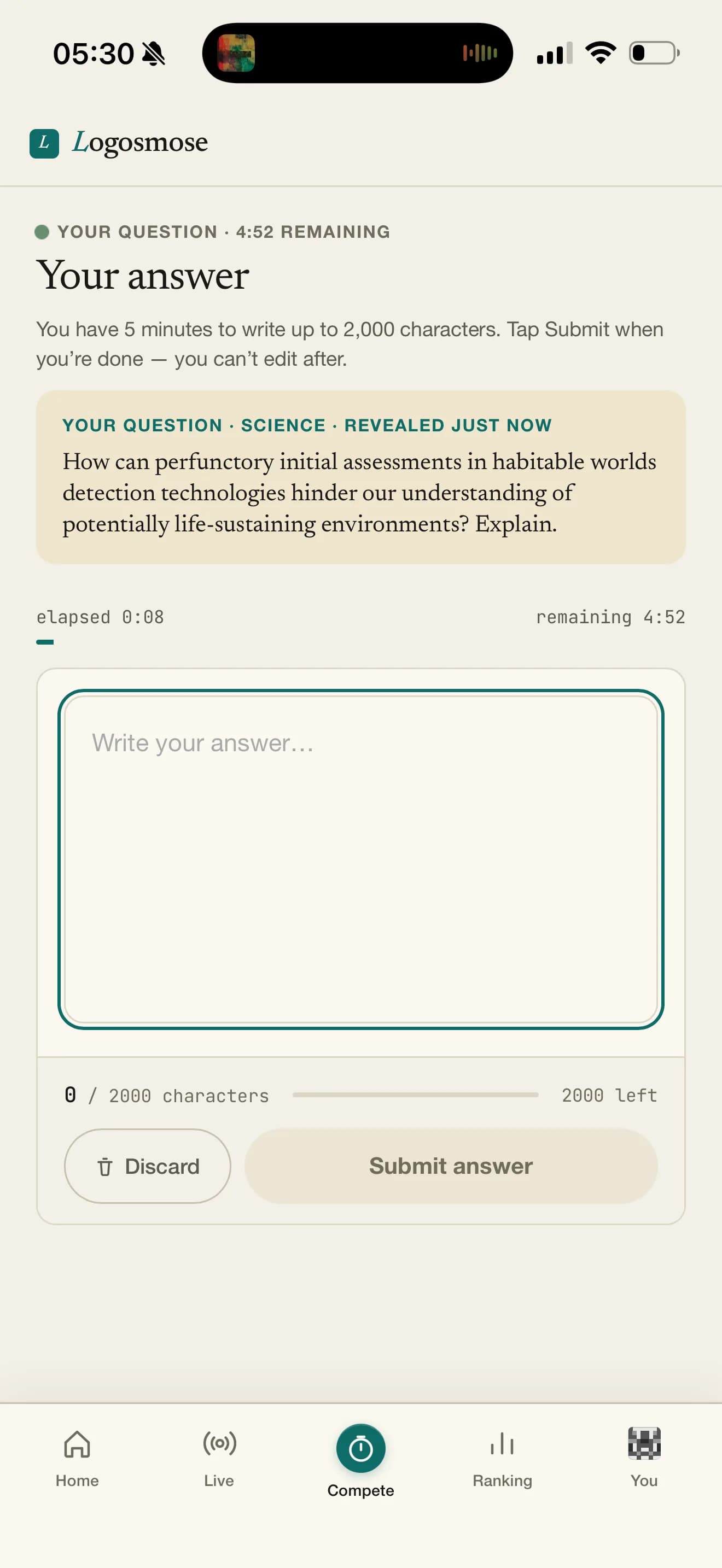
Reveal one difficult question.
Write for five minutes, within 2,000 characters.
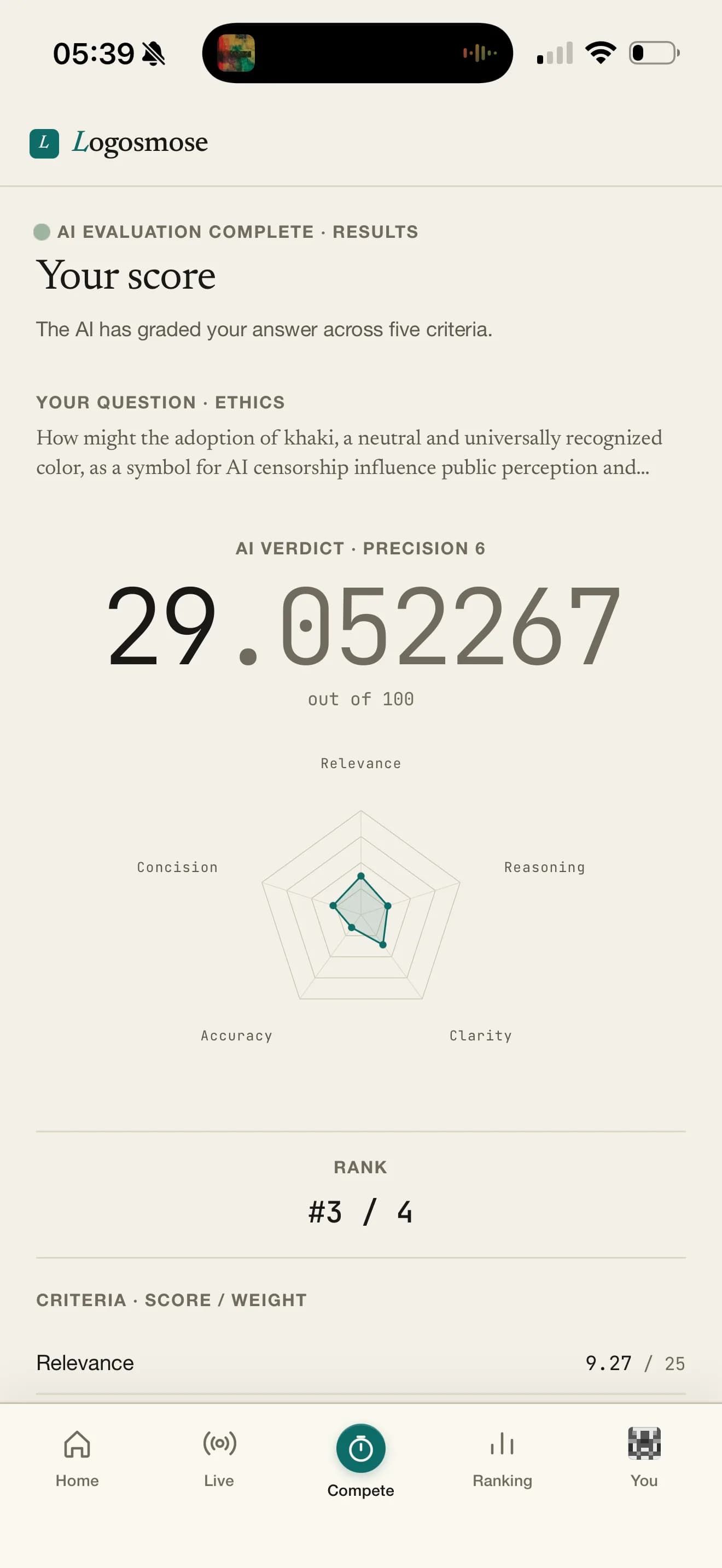
Evaluate the response across five public criteria.
Return the score, criterion breakdown and rank.
One answer reaches four specialist evaluators. Two share relevance and reasoning, one reads clarity and concision, one checks factual accuracy. Their weighted contributions remain visible alongside the result.
Answer; M1; M2; M3; M4; Aggregate; Relevance; Reasoning; Clarity; Accuracy; Concision.
03 / Division of labour
Four providers split a weighted five-criterion rubric: OpenAI and Anthropic share relevance and reasoning, Gemini grades clarity and concision, Perplexity checks factual accuracy. No model controls the verdict alone.
I set the claim, rubric, limits, aggregation rules and wording. Users decide whether the result helps them.
04 / Product evidence
Live screens from free participation and training. They show the interface, not adoption or grading validity.
Reality check / the business model changed
I removed the financial dimension after legal concerns, gambling associations and payment-processor friction. The free product now tests trust and repeat participation before adding commercial complexity.
Do people choose to return?